1D1F creates 140,000 jobs - Alan Kyerematen
The One-district, One-factory (1D1F) initiative of the government has created close to
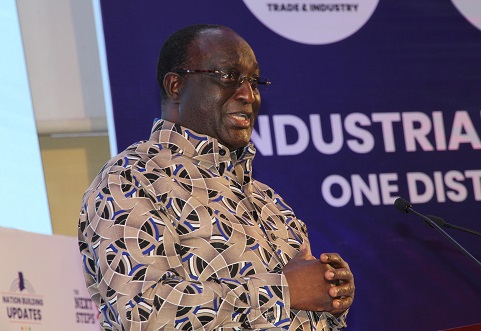
140,000 jobs, the government has revealed.The Minister of Trade and Industry, Mr.
Alan Kyerematen, said of the number, 18,811 were direct jobs, while 120,520 were
indirect jobs.
Mr. Kyerematen was speaking at the Nation Building Updates series
in Accra yesterday.
The series, which are held periodically, under the
auspices of the Ministry of Information, are part of the government's efforts to explain
its policies and also update the citizenry on the progress report of those policies. The
event, held at the Ghana Academy of Arts and Sciences in Accra, focused on the 1D1F and
other aspects of the government's industrialisation agenda.The event, which was on
the theme: "Industrialising Ghana; One district at a time", was also addressed by
the Minister of Information, Mr. Kojo Oppong Nkrumah, and the Chief Executive
Officer (CEO) of the Ghana EXIM Bank, Mr. Lawrence Agyinsam.
Mr.
Kyerematen revealed that 232 projects were currently under the 1D1F initiative.Giving a
breakdown of the projects, he said 76 companies were currently operating, 107 projects
were under construction, 36 were under the mobilisation stage, with 13 more in the
pipeline.Out of the 232 projects, he explained, 64 were existing companies which
were revived or given support to revamp their operations, with 168 being new
companies.
The factories, he added, were distributed across the whole
country, with the Greater Accra Region having the highest number of 44 and Western North
having the least of five.
1D1F initiative
The 1D1F initiative
is one of the major policy decisions of the President Nana Addo Dankwa Akufo-Addo
administration.It is part of the New Patriotic Party (NPP) government's
industrialisation agenda to propel Ghana from being an import-dependent economy to an
industrial economy to boost local production of goods in order to create employment and
drive growth.Per the NPP's Election 2016 manifesto, "it will implement the 1D1F in
collaboration with the private sector to ensure an even and spatial spread of
industries".
Support
The Minister of Trade said as a public-private
partnership initiative, the government was fully providing the necessary support for the
companies for them to thrive and further expand.He mentioned some aspects of the support
as tax incentives, waivers on duties and levies on imported machinery and raw materials,
five-year corporate tax holiday and interest subsidy on loans granted to 1D1F
companies.Other incentives, he said, were free technical assistance to the companies and
the extension of infrastructure, such as electricity, water and roads, to 1D1F project
sites.He stressed the importance of the initiative to the economic growth of the
country, adding: "It is part of the vision of President Akufo-Addo to become a global
power. If you look at the experience of the most powerful countries in the world, they
also happened to be the most industrialised economies of the world. It can, therefore,
not be a matter of chance that the most powerful countries are also the most
industrialised,- he said.
Industrialisation Agenda
Mr. Kyerematen added
that although the 1D1F initiative was a major policy, it was only part of the
government's industrialisation agenda. "Much as the 1D1F is the major component of the
industrialisation programme, it is only one of the 10 key pillars of our industrial
transformation agenda. We believe that this, together with other initiatives, will
constitute the key to moving Ghana from an agrarian economy to an industrialised
economy," - he said.
Mr. Agyinsam said since 2017, the bank had become the major
financier of the government's 1D1F initiative. He said the EXIM Bank alone accounted for
GHc1.2 billion, representing 50 per cent of the total funding of GHc2.3 billion,
provided by the financial institutions in the country, adding that out of the 232
industries supported, "the Ghana EXIM Bank alone supported 120 industries and we have
done so across the country".
He said he was excited that distressed and old
industries which had virtually collapsed over the years, either because of the power
crisis the country suffered prior to 2017 or obsolete machines, were now back and
working.He mentioned the Juaben Oil Company and Darko Farms Ltd as two of such
industries, explaining that it was decided that instead of investing in new factories
under the 1D1F, "it will make economic and business sense to support distressed and old
industries by injecting capital expenditure and working capital". Mr. Agyinsam announced
that the bank had pumped GHc304 million into the pharmaceutical industry and supported
the garment industry with GHc36 million to produce personal protective
equipment.Mr. Oppong Nkrumah said the governance system embarked on by the
government was about trying to improve the quality of life of the people through the
building of a robust economic framework and programmes that would impact people's
lives.