

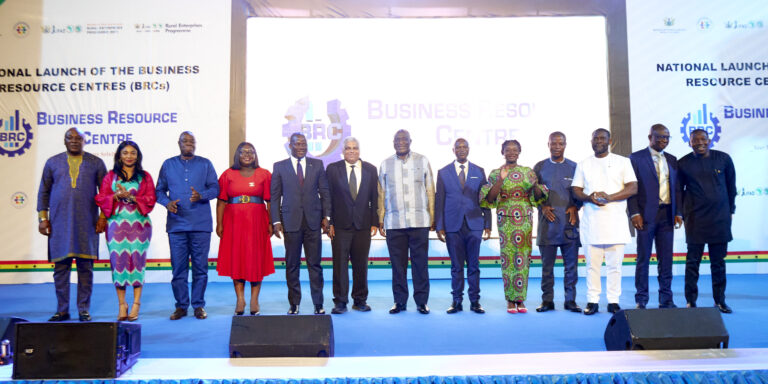
Industrialisation drive: 67 Business resource centres built
The country's industrialisation agenda has received a major boost with the
establishment of 67 business resource centres (BRCs) across the country. They
were set up by the Ministry of Trade and Industry, under the Rural Enterprises
Programme (REP), to support the growth and competitiveness of micro, small and
medium enterprises (MSMEs) and One-District, One-Factory (1D1F)
companies.
The BRCs are providing business development services such as
the identification of business opportunities, business plan preparation,
facilitation of access to finance/credit and business health check, otherwise
known as business diagnostics. Other services include the provision of training
in management and entrepreneurship, business counselling and advisory services,
productivity improvement programmes and capacity building for
institutions.
The BRCs, to be run as profit-making entities, are to be
managed by private sector operators under a franchising arrangement with the
Ghana Enterprises Agency (GEA), the ultimate owners of the BRCs. This is to
ensure the sustainability of operations and maintenance of facilities of the
centres and also the aggressive and guided promotion of business activities in
the country.
Currently, 37 out of the 67 centres are in operation, with
facilities such as reception areas, offices for staff, business
centres/cafes, conference/training rooms, small meeting rooms and
showrooms.
All BRCs are connected to standby generators, solar
power and boreholes and equipped with information and communications technology
(ICT) equipment to support information and communication processes. The
establishment of the BRCs was funded by the International Fund for Agricultural
Development and the African Development Bank (AfDB).
Launch
Speaking
at the launch of the BRCs in Accra yesterday, the Minister of Trade and
Industry, Alan Kyerematen, noted that many countries, especially in Europe,
North America and Asia, had developed their economies by paying more attention
to building strong MSMEs that had grown from family-owned businesses into
multinationals. "The great nations of this world are not where they are because
of their natural resource endowments. If that were the case, countries like
Singapore and South Korea would be the poorest countries in the world and Africa
would be the richest, he said. Those countries are great because of their
commitment to the development of entrepreneurs. There are companies that make
annual turnover larger than Ghana's Gross Domestic Product," he added.
He
noted that many MSMEs in the country had not been able to take advantage of
international trade agreements signed with leading economies in the world due to
some challenges, such as the high cost of credit, weak production and retail
infrastructure, low technology adaptation, and inadequate market
information.
The Trade Minister said it was against that backdrop that
the ministry had, since 2017, been implementing a comprehensive industrial
transformation programme to make the country the new manufacturing hub in
Africa. To achieve that industrial objective, programmes such as re-aligning REP
to provide comprehensive support for MSMEs and 1D1F companies had become
necessary, Mr Kyerematen said.
He noted that Ghana was faced with three
main challenges, namely: unemployment, low revenue mobilisation and lack of
sustained inflow of foreign exchange, which needed to be tackled to put the
country on the right path. "Every year, over 300,000 people graduate from our
tertiary institutions. If we add this to those who complete second-cycle
institutions and those who do not even make it to the second-cycle or tertiary
level, nobody needs to convince us that unless we find a structured solution to
deal with unemployment, we will have national security challenges on our
hands,” he said.
Mr Kyerematen said about 80 per cent of employment
generated in the country came from MSMEs and, therefore, appealed to the
Ministry of Finance and the Bank of Ghana to put together a no-guarantee scheme
that would ease liquidity in the banks to support the development of MSMEs. The
government, he said, must drive the public sector to provide institutional
support and additional development services for MSMEs, saying by doing so, the
MSMEs would start paying taxes that would help deal with the problem of low
revenue mobilisation. “If the only answer to export revenue mobilisation is
proceeds from the export of cocoa, then we may have a problem in this country.
We have been depending on cocoa and gold for over a century for our export
revenue. It must occur to us that we have to move beyond cocoa. We should
mobilise MSMEs to produce for export,” he emphasised.
The country
needed export revenue to be able to finance the development agenda and also
support the local currency, and that could be achieved if MSMEs were supported,
he said.
Other Business Centres
The National Director of the
REP, Kwasi Attah-Antwi, said one of the biggest achievements of the REP was the
huge innovative institutional legacy that was being bequeathed the country at
the district, regional and national levels for the promotion of business
development. “The BRCs are for the promotion of business development services,
engineering technology development, industrialisation, among others,
particularly in the rural areas," he said.
Mr Attah-Antwi disclosed that
aside from the BRCs under the Business Development Service component of the REP,
161 business advisory centres (BAC) had been established in the various
assemblies, adding that through the centres, over 93,031 new businesses and
153,275 direct jobs had been created as of December 2021. At the event, the REP
signed a memorandum of understanding with the GEA regarding their expected roles
and commitment to take full custody of and manage the BRCs under the franchising
scheme.
National assets
The Chief Executive Officer of the GEA,
Kosi Yankey-Ayeh, described the BRCs as huge assets for the nation's growth and
development. She explained that the centres would provide quality direct
implementation support for MSMEs in the country, which would in turn drive the
economy and make it more sustainable and resilient.
Mrs Yankey-Ayeh further
pledged that the GEA, in undertaking its supervisory role over the BRCs, would
ensure that the requisite tools to function were provided as expected. The
Senior Transport Engineer at the AfDB, Sheila Enyonam Akyea, said the
establishment of the BRCs was in line with the bank's policy of helping to
develop the rural areas.
The BRCs would go a long way to support youth
and female-owned businesses and develop the skills set required for the 1D1F
initiative, she added. Ms Akyea said checks had proved that all resources that
went into the establishment of the centres were used appropriately and as
intended.